
Comments
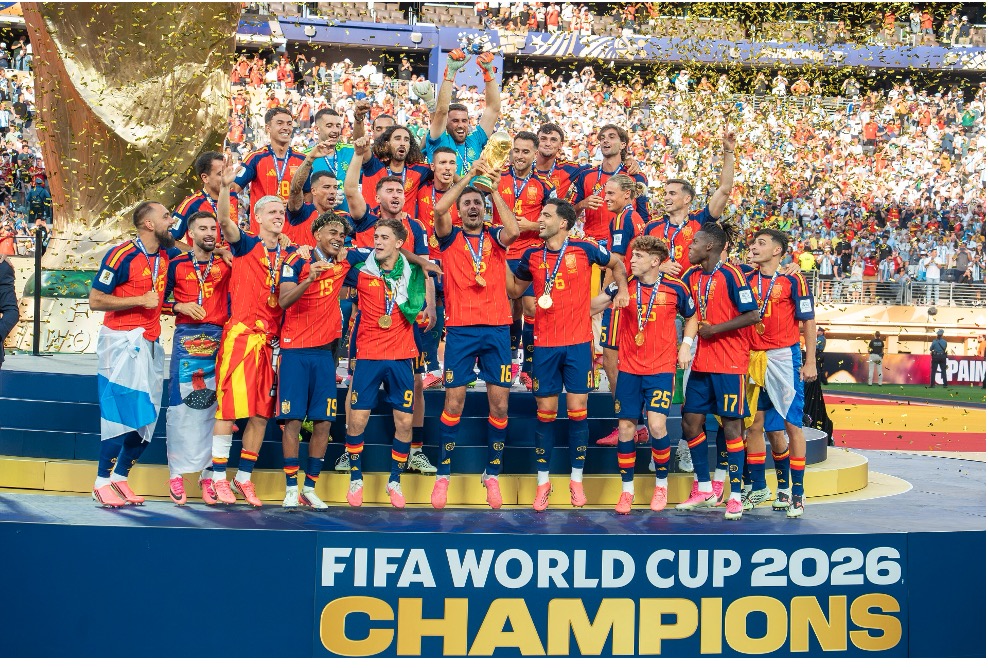
GELFAND’S WORLD - To a lot of American viewers, the World Cup championship game on Sunday must have seemed a bit dull. More of a whimper than a bang, to borrow the old phrase. Maybe it was like the old days in baseball, when the pitcher would repeatedly throw to first base. It seemed dull, but Vin Scully explained to the listening audience that there was really a lot going on under the surface. There was something similar in the World Cup final. Those who appreciate the game found considerable excitement and even a certain amount of satisfaction both in Argentina’s play and in Spain’s victory, but a lot of it was, indeed, under the surface.
Let’s take a moment to consider whether there are any political or economic lessons that the World Cup teaches us in anticipation of the Olympics. Then I will mention a different version of the World Cup coming up in 2027 where the U.S. team could have a good chance to go all the way. Finally, I have a few remarks (a soccer version of View from the Balcony) about the championship final and the winning team.
Everyone seemed happy. Maybe it’s just that people who travel to root for their home team arrive in a hopeful frame of mind. The underpinnings are completely different from what we used to see in the Olympics, when the Nazi regime tried to prove its racial superiority or the Soviet regime tried to prove its systemic superiority.
I don’t know whether our overseas guests liked the hotel accommodations or the way we do hot dogs, but we seem to have gotten through everything with a minimum of trouble. There were a few, rare exceptions, but they occurred over three different countries and in and around a hundred-plus games. It wasn’t the Munich Olympics or even the Atlanta games. Everything seemed sunny and cheerful. So we have some reason to hope that we can host the 2028 Olympics in a peaceful and sunny atmosphere.
But there are things we have to consider. The Los Angeles games are going to be held under the authority of a Republican administration, whether it is Donald Trump or J.D. Vance at the helm. (It is always possible that there could be some other team at the top – as we saw when Vice President Spiro Agnew resigned from office, later followed by Nixon’s resignation -- but we are going to have some sort of Republican administration. How it behaves is going to be a matter of temperament.
Trump likes to offer up threats and, for the most part, abandons them within hours. We’ve seen that over the Strait of Hormuz and – yes – regarding the World Cup over the past year. Remember when we were concerned about ICE raids during World Cup matches being held in U.S. stadiums? When it came time for the games themselves, the threats were quietly ignored, but I suspect that their history has left a sour tasted in the mouths of our local 2028 Olympics organizers. Or to put it more directly, how can the LAPD and the city government plan intelligently around such craziness?
We ought to be assuming that Donald Trump will be in office, because we have to prepare for the worst, as the old saying goes. And once you make that assumption, you have to remember that the Olympics will be taking place in the run up to the 2028 general elections. The presidency and the control of both houses of congress will be on the line, and we can anticipate all the fear-mongering and hate-mongering that we are seeing right now in anticipation of the midterm elections. Will this affect the games? Anybody’s guess.
With a little luck, Trump (or whoever is in charge) will sit back, let the games go on, and try to take credit for everything that the rest of us have done. That would be the best case scenario.
But the one thing that the World Cup did not reveal is how the city of Los Angeles is going to deal with cost overruns, traffic jams, and civic unrest. The current city administration does not have the financial resources to do the kind of planning and preparation that would guarantee peace and efficiency. They talk hopefully, but they have not, so far, displayed the leadership that would make the Olympics look like the World Cup.
In addition, the Olympics are a lot more complicated, in the sense that the World Cup was one kind of game repeated a hundred times. The Olympics will include volleyball, track, gymnastics, archery, and even sailing. There are a lot of different kinds of venues that have to be created. Luckily, we already have much of what will be required, but what is our response when some sporting federation demands expensive changes during the year 2028?
A World Cup we can win
Going back to the early 1990s, there has been a World Cup for women. Those of a certain age will remember the monumental battle during the 1999 championship game in the Rose Bowl. The name Mia (as in Mia Hamm) became nationally known during that tournament. Over the years, there have been 9 Women’s World Cup tournaments. What brings particular pride is that the United States have won 4 times. Compare that to every other country in the world: Germany has won twice, and three other countries have each won once. There are scholarly explanations for why our teams do so well. One requirement of a 1960s era civil rights law created a certain level of equality in women’s collegiate sports, and this led in its own way to the funding and expansion of women’s soccer programs in American colleges. Other countries that were already heavily invested in men’s soccer began to field their own women’s teams, but the Americans were able to start and get into the game on pretty much an even playing field. We have lots of players at the youth level, and they have been able to find teams and scholarship support in American universities.
As recently as 2019 and 2015, our teams won back-to-back World Cup championships. We didn’t do well in 2023, but the team came back to win the Olympics the next year (for the fifth time).
So let’s see how things go in that other World Cup. It will be in Brazil in 2027.
A View from the Television Seats: the 2026 World Cup
Viewers noticed early on that professional soccer games are designed to go 90 minutes. That was the rule for the first 3 games each team played, but in the next phase (known as the knockout round) ties are not allowed. When a game is tied at the end of the regulation 90 minutes, an extra 30 minutes is added on. (We won’t go into the penalty kick tie-breaker at the end of 120 minutes.) Basically, the knockout phase works the same way that the NCAA basketball tournament works – essentially a big bracket going from 32 teams to 16 teams to 8 teams and so on.
In practice, this means that the top two teams play a total of 8 games each, and every game is at least 90 minutes long. Some games (such as Sunday’s championship final) go 120 minutes because of that additional 30 minutes to break the tie.
Why all this math? It is simply to show that the top teams and the semi-finalists and quarter-finalists played pretty close to a whole college football season (at least in minutes played) during a 5 week period. Spain and Argentina each played at least 750 minutes. But there is more: Soccer does not have free substitution the way American football and basketball have. Once you are substituted out of the game, you are gone. And one last thing – the number of substitutes is strictly limited, so most starters go the entire way, whether it is 60 minutes or 90 minutes. And that soccer field is actually 15 yards longer (and 20 yards wider) than our American football fields, so there is that too. Those guys played a lot of minutes and ran a lot of miles in so doing.
Now here is the fact of the 2026 World Cup that ought to be most noted: In its 8 games, Spain gave up a total of 1 goal. In fact, that single goal went to Belgium after nearly 500 minutes that Spain had already played in this tournament.
To the naive viewer, much of what we saw on Sunday might have seemed like a bunch of guys just kicking the ball around the yard, with little to compare to hitting a basket in the NBA or a touchdown drive in the NFL. What American viewers often miss is that every time a professional soccer team gets possession of the ball, it’s equivalent to an American football team going for it from the other team’s 15 yard line. Anything can happen.
What’s equally true, although a little less obvious, is that it’s the same thing – anything can happen -- whenever either team passes the ball. That’s because an intercepted pass in soccer is like a fumble or an intercepted pass in American football. This is when a soccer player takes the ball, breaks into the open and frightens the goal keeper half to death.
Spain is a great team, and just like the Chicago Bears of 1985, great defense is compelling. You can’t win if you can never score a goal, and Spain put its opponents into that bind.
(Bob Gelfand writes on science, culture, and politics for CityWatch. He can be reached at amrep535@sbcglobal.net)