Comments
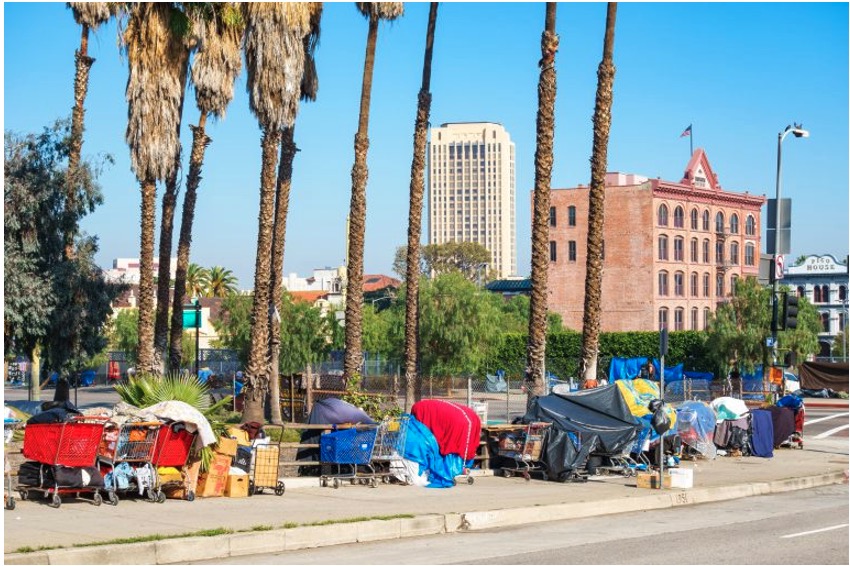
PLANNING WATCH - One of the ironies of Los Angeles is the simultaneous increase in homeless and overcrowding when vacancy rates are also increasing. How can we explain this?
- One explanation is the unreliability of homeless stats. They depend on volunteers going out at night to document the homeless people they encounter in their assigned areas.
- Another explanation is the decline in personal income to the point that a growing number of people and families cannot afford a roof over their head, even though some housing costs are declining.
Both explanations have a kernel of truth, but the second one explains more. Basically, increasing housing costs and flat incomes have forced many people to sleep outside or live in overcrowded conditions,
What do we know about falling prices of housing? According to the LA Times house prices are falling . Part of the explanation is that for the past four years, prices for upper-end housing have declined. But over the same time period, when controlling for inflation, most wages have also declined. In combination, the vacancy rate has increased, although the price of low-priced residences has increased the most. If we compare growing housing prices to incomes, we see the following trends. The most inflation has appeared in lower-priced housing, where there is the most unmet demand for lower-priced apartments.
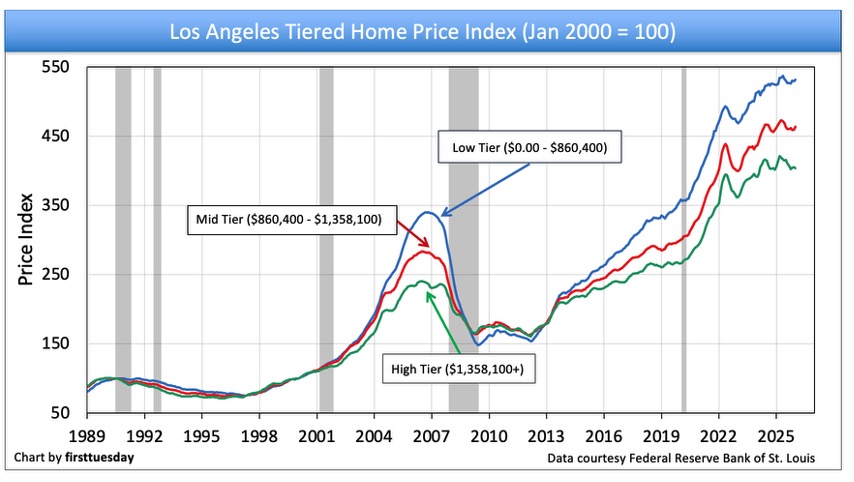
If we then look at personal income controlled for inflation, real wages hardly changed, even though the average selling prices of houses increased from $600,000 to $900,000 over the past decade.
Unfortunately the charts do not perfectly synchronize with each other, but together they reveal that the price of shelter in Los Angeles has exceeded the growth in real income for most Angelenos. Of course the top several percent have so much money that they are immune from these underlying trends. As for those who formerly qualified for public housing, they are likely to become homeless or overcrowded since there has not been any new public housing built since Nixon era, over 50 years ago.
As for the upper middle class, the middle class, and the poor, the increase in house and apartment prices hit them hard. That is why we can expect the simultaneous growth of vacancy rates and homelessness and overcrowding rates. What good are abundant vacant residential units if the homeless and overcrowded cannot afford them? Furthermore, we cannot explain these trends away with anecdotes about drug addiction and mental illness. These conditions only apply to only about one-third of the homeless and even less to the overcrowded. Furthermore, unlike the present, in previous periods the mentally ill and overcrowded had shelter, sometimes provided by the local police.
To understand the growth of homelessness and overcrowding at present, it would be a grave mistake to explain it as the sudden emergence of homeless people. Their numbers have dramatically increased as the alternatives for low cost shelter disappeared. It has nothing to do with the people, and everything to do with the availability of housing. It also explains why some countries, like Japan, have no homeless people and why other countries, like the US, have so many. The people did not suddenly change. Instead it was public housing that changed. In fact, in the U.S. nearly all homeless housing is provided from the uncooperative private sector.
Conclusion: The housing crisis has never ended, especially for low-income people.
(Dick Platkin (rhplatkin@gmail.com) is a retired LA city planner. He reports on local planning issues and is a board member of United Neighborhoods for Los Angeles. Previous columns are available at the CityWatchLA archives.)