
Comments
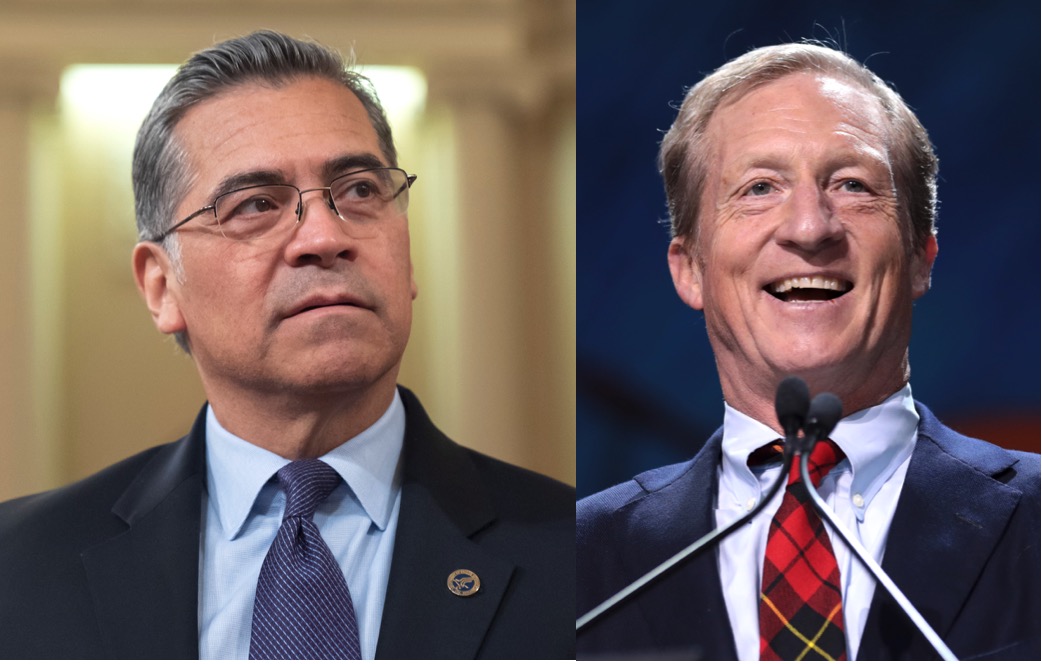
GELFAND’S WORLD - Unless things change dramatically, California Democrats and independents should coalesce around Tom Steyer and Xavier Becerra, because they have been the leaders in almost all recent polling. The other Democratic candidates should drop out and endorse those two. The important names here are Porter and Mahan, who together could point 20% of the voters towards a runoff featuring two Democrats.
The second governor’s debate has come and gone. Perhaps things will be a little simpler now because Republican candidate Bianco made such a jerk of himself in the debate.
Once again, the propensity of debate moderators to insert themselves into the discussion is the huge structural weakness. I’d like to explain this remark by pointing out how one moderator handled her part of the proceedings. The debate was divided into three parts, with a different cast of moderators for each part.
Julie Watts, who anchored the middle segment, was irritating and insulting all at once, starting out with a threat to shut off microphones, as if she were a school teacher. And when we were done, it turned out to be a lot of rapid enunciation of routine points. She managed to achieve one thing that deserves condemnation at any level: She carried out a “gotcha squared.” Let’s consider.
In the previous debate, one moderator achieved the original gotcha by asking a bunch of Democrats to grade their party’s leader, the governor of California. That’s roughly equivalent to asking Speaker Mike Johnson to grade the president over something he had done. It’s a question equivalent to “Does this dress make me look fat?”
There is no correct answer, which is apparently why reporters seem to think that they want to ask such things.
So there we were in the second governor’s debate, and this time the moderator threw the previous answers at the candidates: “You gave Governor Newsom an A on homelessness . . . “
Here is an honest answer: “I am a professional politician, which requires balancing out a lot of competing interests. The previous question was basically asking me to speak critically about one of our party’s most respected leaders. Let me just remind you of what Ronald Reagan called the eleventh commandment: “You shall not speak ill of any other Republican.” We have a similar tradition in the Democratic Party. If you want to ask a real question about some significant topic, I will be more than happy to answer. But right now you are just playing games and wasting the time of lots of viewers.”
Wouldn’t that have been refreshing?
In a discussion of the first debate, I was tempted to point out that these events are beginning to sound like Gilbert & Sullivan without the wit. The idea is to put as many words together in as short a time as possible. You can listen to one such example here. That’s what was going on in the middle of the debate.
In that painful second section, I could barely catch my breath as the moderator raced through her final remarks. She didn’t so much wind down as just go to commercial. And what was left was this feeling: We weren’t really learning about the candidates as people or as potential governors. We were just learning about them as candidates.
There was one candidate who did let us know something about himself, and that was the other Republican, Chad Bianco. He repeatedly announced that what we were hearing from all of the Democrats (and presumably from the moderators) was nothing but lies. It became obvious that he is someone whose entire exposure to political thought comes from right wing sources. He is, to borrow the old expression, in the bubble. That was also made clear by the fact that once again, he referred tauntingly to the “Democrat Party” instead of by its real name.
And once again, no moderator ever corrected him on the slight. This is continuing journalistic malpractice.
Republican Steven Hilton once again held his own, but again mainly through force of personality rather than through some superior force of argument. He did, this time around, admit to working in high levels of British government and with a Prime Minister. Once again, he didn’t bite on the remark by a Democrat implying that he was just a Fox News personality.
Also of interest was the moment when one of the moderators asked Hilton an open-ended question which, in essence, invited him to explain how he could function effectively as governor in the presence of veto-proof Democratic supermajorities in both houses of the legislature. A more experienced politician would have pointed out that every seat in the Assembly is up for election in November, and that the voters could therefore add a few Republicans into the mix.
He did manage to point out that he would wipe regulations off the books. The moderator dropped the ball by failing to point out that regulations are important in protecting our health and safety.
So who did well, who did not do well, and how should we score this debate in terms of coalescing around one or two Democrats to support in the June 2 primary election?
As I mentioned at the beginning, Steyer and Becerra have been at the top of the Democratic Party polling. Unless there is some dramatic shift in the next few days, the Democratic strategy is obvious. Porter, Mahan, and the minor candidates should drop out and endorse the remaining two.
As for the debate, Becerra held his own. Steyer struggled a bit in parts, but did well enough overall because he managed to enunciate his one major argument, that he is the agent of change.
Voters will be receiving mail-in ballots shortly, so there isn’t much time left for the Democratic Party to put its affairs in order.
(Bob Gelfand writes on science, culture, and politics for CityWatch. He can be reached at amrep535@sbcglobal.net)