Comments
iAUDIT! - At the conclusion of the classic pre-Code gangster movie “Little Ceaser”, Edward G.Robertson’s egotistical fallen crime boss Rico Bandelo lies dying in a back alley. Astonished that he’d finally been brought down by the police, his last words are “Mother of mercy, is this the end of Rico”? Most of the film follows Rico’s meteoritic rise in New York’s crime syndicates, from a common street thug to a high-style mob boss. Aong the way, he dodges assassination attempts and taunts the police with ever more brazen heists, until he believes he’s invincible. In his last moments, reality comes crashing down around him. On the run, destitute, and desperate, he dies in a futile gunfight with a group of equally hardboiled detectives.
The movie’s moral, if there is one, is that hubris eventually leads to destruction. Rico rose so high so quickly, he thought he’d never be brought down. He was betrayed by his own sense of infallibility. That is certainly a lesson to be learned for anyone among us who is infected with conceit and overweening pride, and for some organizations as well. The events of the past couple of weeks have certainly taught that lesson to the leaders of the Los Angeles Homelessness Services Authority (LAHSA).
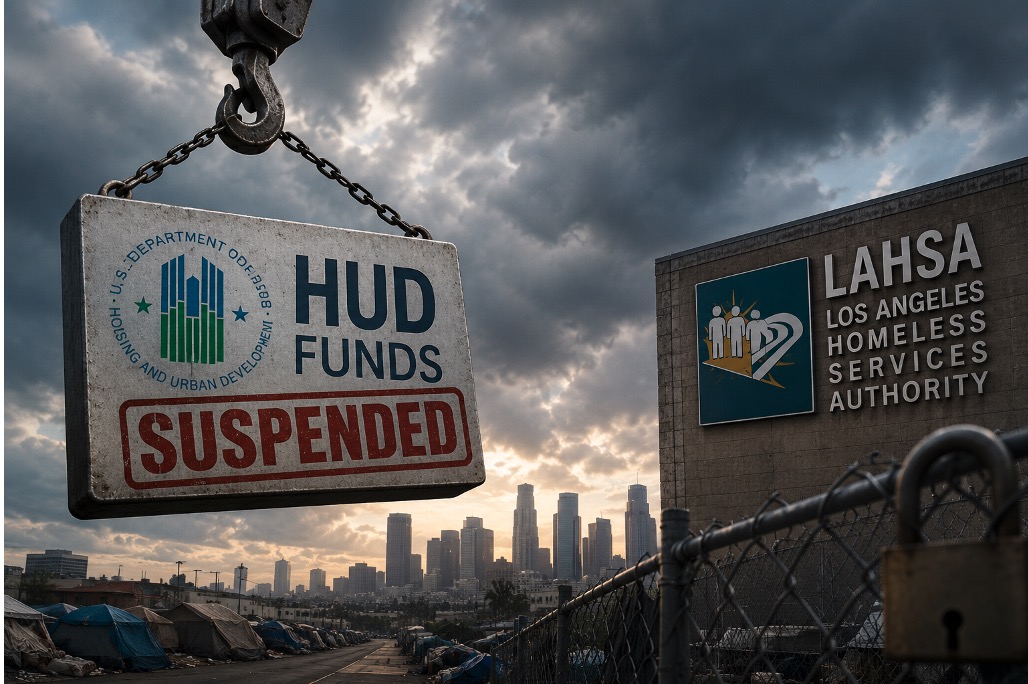
On June 11, the US Department of Housing and Urban Development (HUD) notified LAHSA it was suspending all funding sent to the Authority. Although the press release that accompanied the letter is full of the expected political rhetoric, the letter itself is objective and damning. Over its 13 pages, it details decades of mismanagement and alleged violations of federal law. Many of the problems cited in the letter are ones I have written about in past columns, including negative audits from the City Controller, the County Controller, and HUD itself. Since the audits’ findings are summarized in HUD’s letter, I won’t repeat them here, except to note that neither LAHSA nor the City nor County have done anything substantive to correct the problems. One of the most shocking things about all of the audits and reports is how repetitive they are. For two decades, LAHSA has had many chances to correct its financial and program management practices, and has done almost nothing. As early as 2007, HUD auditors questioned LAHSA contract and funding practices, yet a LA County Auditor’s report from May 2026--one month ago--cited weak documentation and incomplete financial records. The inability to produce proper records was cited in a court-ordered review of homelessness programs in May 2025, and in LAHSA’s most recent federal Single Annual Audit.
Clearly, successive generations of LAHSA’s leadership have depended on the Authority’s deeply ingrained political connections to protect it from the need for reform and from the consequences of failure. As I have written several times in the past, the City, County, LAHSA, and a group of large corporate nonprofits trade leaders like baseball teams trade players, ensuring the same policies will be funded year after year. Like Rico Bandelo, LAHSA’s leaders came to believe terms like accountability and responsibility were nothing more than campaign slogans and catchphrases in press releases, and they would be insulated from true reform. HUD’s funding suspension shattered that illusion.
LAHSA’s reaction was immediate and unusually brief. A few hours after HUD’s suspension was released, LAHSA’s Communications Director issued a press release:
“Today, HUD announced an action that could put thousands of formerly homeless people back on the street. LAHSA received a letter from HUD announcing a suspension of CoC funding. After initial review, this appears to be a blatant attempt to pull yet more resources from Los Angeles, a city they have targeted time and again, when it is clear that LAHSA has either corrected or is in the process of correcting nearly all of the issues raised.
Local oversight actions have already resulted in strong repairs and reforms to LAHSA’s internal controls, which are accountable and viewable to the public. We are also beginning to implement KPMG’s recommendations to modernize our financial systems and prevent similar findings from occurring again. If HUD’s Inspector General actually conducts a fair review of LAHSA’s current and future practices, they will clearly see how our systems now allow us to clearly track the work and investments that have resulted in LA outperforming the nation by reducing homelessness over the last two years.
While the review plays out, our immediate priority is to explore all available options to ensure that federal funds continue to support the thousands of people who have been housed through LAHSA and our broader rehousing system”.
As I pointed out in a Substack article on the same day, LAHSA’s claims of “repairing” its insufficiencies are laughable since it has been working on the same “repairs” for 20 years.
As if the suspension wasn’t enough of a shock, on June 1, HUD announced new priorities in its annual Notice of Funding Opportunity (NOFO) for homelessness programs. The NOFO called Housing First a “failed experiment” and funding policy will now emphasize transitional housing and recovery services over permanent housing. Housing First has formed the basis of homelessness interventions in LA for 30 years and has provided public agencies and nonprofits with an increasing funding stream they have come to depend on, despite a lack of substantive results. Redirecting money away from Housing First towards performance-based recovery programs is a major shock to LA’s entrenched homelessness structure.
As expected, Los Angeles’ political leaders circled the wagons to defend LAHSA. One June 15, LA’s City Council voted 14-0 to condemn the funding suspension. Council President Marqueece Harris-Dawson claimed HUD was condemning thousands to life on the streets, saying, "You don't solve that by kicking houseless people out on the street”. LA County Supervisor (and former LAHSA Commission Chair) Lindsey Horvath accused HUD of staging a publicity stunt. In an LA Times article, Mayor Bass said, “…a sudden suspension of federal dollars not only threatens recent progress but “ultimately people will lose their lives.” The irony of some of these statements should be inescapable to those who follow homelessness in LA. Both Mayor Bass and Supervisor Horvath served on LAHSA’s Board of Commissioners and had many chances to demand reform. Lately, Horvath has been an especially vocal critic of LAHSA, leading the charge to withdraw County funding from the Authority to create a County Department of Homelessness, which will merely move the same failed programs from one place to another.
Against the widespread condemnation of HUD’s actions, we must consider the reality of homelessness program performance in Los Angeles. On the same day HUD’s suspension letter was released, LAist reported that the City has been paying for at least 250 vacant apartments rented through LAHSA’s master leasing program. The lease contracts pay landlords for apartments whether or not they are occupied, and neither the City nor LAHSA has been monitoring occupancy rates. The day after HUD issued the letter, LAist published another article detailing how LAHSA has underspent tens of millions in funds meant to mitigate homelessness. LAHSA attributed the underspending to “program delays”, which can be code for inefficient and ineffective management. The article also noted LAHSA had to return $3.5 million in federal grants because it didn’t use the money by the funding deadline. In another case of unintended irony, Mayor Bass said she “has grave concerns about LAHSA and zero tolerance for mismanagement and negligence.” Yet the City has done little better than LAHSA; a March 26 letter from the City Controller noted the City did not have plans to spend $473 million of its $1.1 billion in homelessness money.
Given the City’s and LAHSA’s track record of underspending, claims that thousands of people will be left homeless seem a bit hypocritical. Thousands are already on the streets because local programs aren’t working. As I wrote in a January 2026 column, the claims of significant decreases in unsheltered homelessness cannot be verified. Indeed a RAND survey shows homelessness in three key areas has remained steady while unsheltered homelessness has increased. If local agencies had done a better job using federal money, perhaps HUD wouldn’t be suspending its funding.
One thing that has caused such apoplexy among local officials is that HUD isn’t just pulling LAHSA’s funding, it is suspending all federal money to the City and County, because that money is granted to LAHSA, then distributed to the Citty and County for their own homelessness programs (in a situation only the federal government can create, much of the money LAHSA sends out comes back to it through service agreements). Therefore, local officials’ vocal defense of LAHSA isn’t just altruistic; if HUD follows through with its suspension, City and County programs will lose their funding, too, and the large nonprofits that have seen their revenues skyrocket will be scrambling for dollars.
To be sure, HUD’s suspension raises serious questions. While it may be viscerally satisfying to see LAHSA finally be held to account for years of mismanagement, there should be some kind of plan to replace it with a new structure. Some programs do help the unhoused, and they should be preserved. The suspension poses practical problems, too. LAHSA is LA County’s designated Continuum of Care (CoC) agency, responsible for coordinating funding and other regional activities. How will it perform the annual HUD-required Point in Time if it has no money? What can be done in the short-term to restore funding to the City and County so it can continue programs worthy of support?
Despite these questions, LAHSA and local officials have no one but themselves to blame for the funding suspension. For more than 20 years, they have ignored or opposed calls for reform, instead relying on rhetoric and political relationships to maintain the status quo. Now they are confronted with the reality that things will change despite them. They can either respond by embracing change and creating a new homelessness structure in LA, or fight it, and have change imposed upon them.
(Tim Campbell is a longtime Westchester resident and veteran public servant who spent his career managing a municipal performance audit program. Drawing on decades of experience in government accountability, he brings a results-driven approach to civic oversight. In his iAUDIT! column for CityWatchLA, Campbell emphasizes outcomes over bureaucratic process, offering readers clear-eyed analyses of how local programs perform—and where they fall short. His work advocates for greater transparency, efficiency, and effectiveness in Los Angeles government.)