
Comments
SUPREME COURT - By any honest reading of American history, the work of Martin Luther King Jr. was never just about speeches—it was about access. Access to the ballot. Access to representation. Access to the promise of democracy itself.
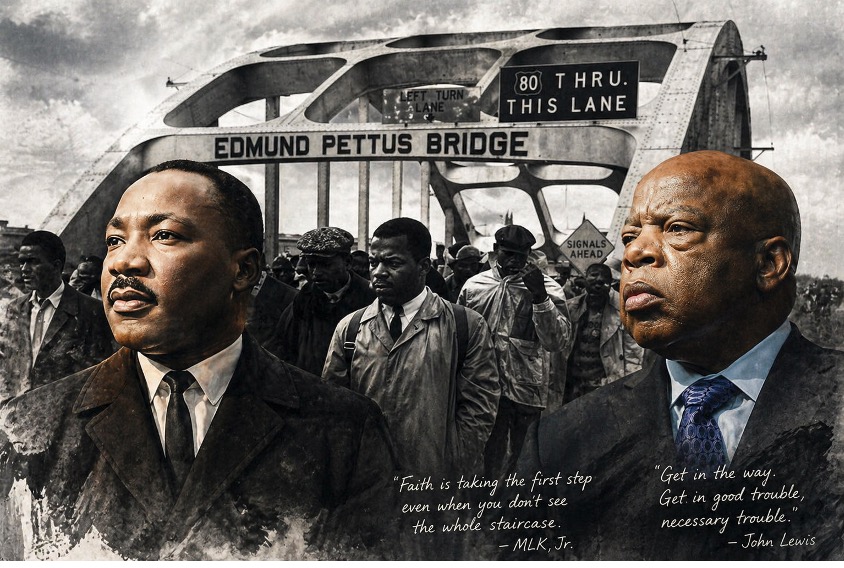
That work carried forward through leaders like John Lewis, who bled on the Edmund Pettus Bridge so that future generations would not have to fight for the simple right to vote.
Today, that legacy is once again under pressure.
A Decision With Deep Consequences
A recent Supreme Court ruling has dramatically altered the landscape of voting rights in America, particularly around the use of majority-minority districts. Critics argue that the decision effectively weakens protections that were central to the Voting Rights Act of 1965—one of the crowning legislative achievements of the civil rights movement.
Lawmakers warn the ruling could reshape congressional maps across multiple states and potentially shift political power by enabling new district lines that diminish minority representation.
Supporters of the ruling argue it restores constitutional limits on race-based districting. Opponents see something far more troubling: a rollback of hard-fought gains that date back to the era of King and Lewis.
The Long Arc—And the Setbacks
King often spoke of the “arc of the moral universe” bending toward justice. But he also understood that the arc does not bend on its own. It requires pressure, sacrifice, and vigilance.
John Lewis echoed that sentiment decades later, urging Americans to make “good trouble” in defense of democratic rights.
The Voting Rights Act was not simply a law—it was a response to a brutal reality: a system designed to exclude. Poll taxes, literacy tests, and intimidation kept Black Americans from the ballot box. The Act aimed to dismantle those barriers and ensure fair representation.
The concern today is not that those exact tools are returning, but that new structural changes—like redistricting rules—can achieve similar outcomes more subtly.
Representation at Stake
Majority-minority districts were created to ensure that communities historically shut out of power could elect candidates of their choice. The Supreme Court’s ruling raises the bar for justifying those districts, making future challenges more difficult.
According to critics, that could lead to fewer districts where minority voters have meaningful influence—effectively diluting their voice in Congress.
Supporters counter that districts should not be drawn primarily on the basis of race, emphasizing a race-neutral interpretation of the Constitution.
This is the tension at the heart of the current moment: equality under the law versus equity in representation.
Echoes of the Past
Democratic leaders have warned that the decision risks pushing the country backward, invoking comparisons to the pre–civil rights era when minority participation was systematically suppressed.
That may sound dramatic—but history has a way of repeating itself, not in identical form, but in familiar patterns.
King’s movement was about opening doors. The question now is whether those doors remain fully open—or are being quietly narrowed.
The Legacy
The legacy of Martin Luther King Jr. and John Lewis is not frozen in history. It is a living challenge to every generation.
The Supreme Court’s decision does not end voting rights. But it does redefine the battlefield.
And that brings us back to the central question both men spent their lives answering:
Who gets to participate in American democracy—and on what terms?
That question is once again up to us.
(Jim Hampton is the Publisher and Editor of CityWatchLA.com. With over 40 years of experience in radio broadcasting, marketing, and content creation, Jim helped launch CityWatch online with founding editor Ken Draper more than two decades ago. He continues to guide the platform’s mission to provide independent news and opinion on Los Angeles government, policy, and civic life.)