Comments
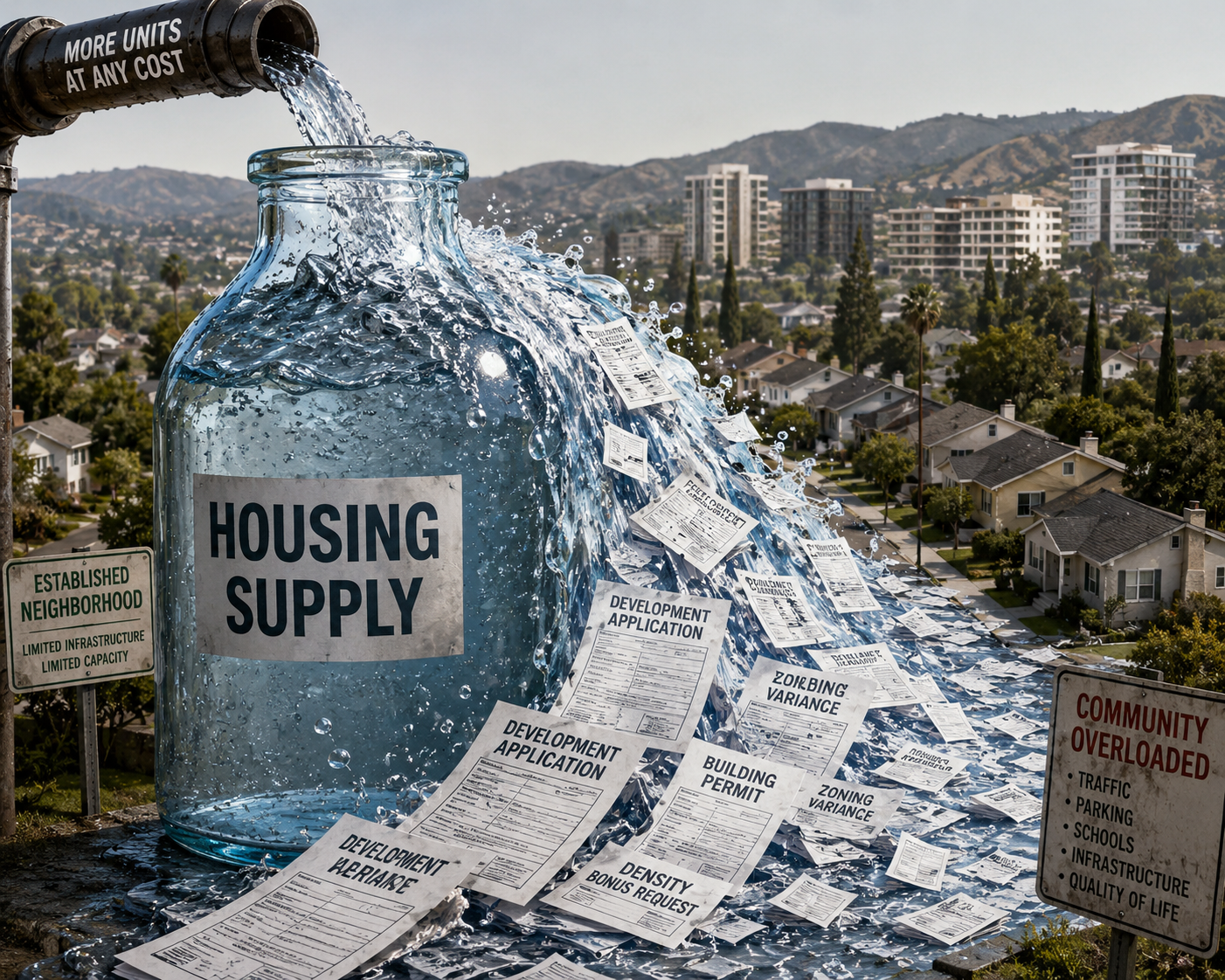
CITY PLANNING - Imagine a 16-ounce bottle.
If I pour 32 ounces into it, I haven't solved a beverage shortage. I've simply made a mess.
That is increasingly how housing policy feels in Los Angeles.
According to Sacramento and City Hall, every problem has the same solution: more density, more streamlining, more up-zoning, more exemptions, and fewer opportunities for communities to object.
Housing too expensive? Build more.
Homelessness increasing? Build more.
Traffic unbearable? Build more.
Infrastructure strained? Build more.
The answer is always the same: pour more into the bottle.
But nobody seems interested in talking about the bottle itself.
Roads have limits. Water systems have limits. Power systems have limits. Schools have limits. Emergency services have limits. Evacuation routes have limits.
And nowhere is that discussion more important than in the San Fernando Valley, where communities are increasingly being told that every ranch property, equestrian lot, open space, and neighborhood plan is simply another development opportunity waiting to be monetized.
The irony is that Los Angeles is simultaneously experiencing population loss, rising vacancies, worsening affordability, increasing homelessness, and worsening overcrowding.
If that sounds contradictory, that's because it is.
Perhaps the problem isn't a housing shortage.
Perhaps the problem is an affordability shortage.
A vacant luxury apartment doesn't help a family that can't afford the rent. An unsold condominium doesn't help a senior living on Social Security. A newly constructed market-rate project does not magically solve homelessness if the people most in need cannot afford to live there.
Yet Sacramento continues to pass streamlining bill after streamlining bill, each one promoted as the solution.
The sales pitch never changes.
If we can just remove enough local review, weaken enough planning requirements, override enough community plans, and reduce enough public oversight, affordability will somehow appear.
Funny how affordability never seems to arrive.
What does arrive are larger projects, larger profits, larger campaign contributions, and larger demands on already strained infrastructure.
Residents of Granada Hills are watching this dynamic play out in real time through the proposed MorningStar assisted living and memory care project, where concerns about wildfire evacuation, infrastructure capacity, and public safety have collided with California's growing culture of streamlining and expedited approvals. Whether one supports or opposes the project, it illustrates a larger question: when does infrastructure capacity become more important than project approval?
City officials cannot seriously claim they do not understand who is truly being squeezed by California's housing costs.
The people who keep Los Angeles functioning are teachers, nurses, restaurant workers, police officers, firefighters, paramedics, caregivers, sanitation workers, and countless others whose work makes our communities possible.
If affordability is truly the crisis, then why are we not focusing more attention on helping these workers afford to live closer to where they serve?
Wouldn't workforce housing assistance, down-payment assistance, employer-supported housing, and targeted affordability programs address the problem more directly than endlessly rewriting zoning codes?
A teacher should not have to spend three hours a day commuting because the community where she teaches has become unaffordable. A firefighter, police officer, nurse, or caregiver should not have to live two counties away from the people who depend on them.
Those are affordability problems.
They are not zoning problems.
Yet policymakers continue to behave as though increasing density is the answer to every question.
If that strategy were working, affordability would be improving. Instead, population is declining, vacancies remain significant, rents remain high, homelessness persists, and overcrowding continues.
At some point, elected officials must acknowledge the possibility that they are treating the symptom while ignoring the disease.
Another uncomfortable reality rarely discussed is that housing has become dramatically more expensive to provide.
Fire insurance has exploded. Earthquake insurance remains costly. Utilities continue to rise. Property taxes increase. Labor costs increase. Construction materials increase. Maintenance costs increase.
Many small property owners are not sitting on piles of cash. They are struggling with the same inflationary pressures everyone else faces.
You cannot solve an affordability crisis by pretending costs do not exist.
Nor can you solve it by pretending every community has unlimited capacity.
I spent a good part of my adult life in Chicago. I understand urban living. I understand apartments, traffic, transit, and growth.
What I don't understand is why Los Angeles planners increasingly act as though infrastructure no longer matters.
Growth requires planning.
Density requires planning.
Public safety requires planning.
Evacuation requires planning.
Ignoring those realities doesn't make them disappear.
It simply transfers the risk to the people who already live there.
There is another question Sacramento rarely seems interested in asking.
What happens to homeownership?
Not homeownership rates.
Homeownership itself.
For most middle-class Americans, a home is not merely a place to live. It is often the single largest investment they will ever make. It represents decades of mortgage payments, maintenance, property taxes, insurance premiums, and financial sacrifice.
People count on that investment.
They count on it to help fund retirement.
They count on it to help pay for assisted living.
They count on it to provide financial security during the final decades of their lives.
Now many homeowners are beginning to wonder whether that social contract still exists.
Residents of Sherwood Forest in Northridge are confronting that question today.
For decades, Sherwood Forest was known for its one- and two-acre estates, mature trees, open space, and distinctive character. People invested there precisely because that was the community they believed they were buying into.
Today, developers are increasingly targeting those same large residential lots for subdivision and intensified development. Properties that once contained a single home are being reimagined as multiple housing sites. Lots that helped define the character of the neighborhood are becoming opportunities for additional density.
Residents are left asking a simple question:
What exactly were they investing in?
A home in a planned community with established expectations?
Or merely a temporary placeholder until Sacramento decided a different use was more profitable?
The changes are routinely justified as necessary to address affordability or a housing shortage.
Yet if affordability remains elusive, homelessness persists, vacancies remain significant, and working families still cannot afford to buy homes, residents are entitled to ask what exactly is being accomplished.
Residents are increasingly left wondering whether community planning still means anything at all.
For decades, Los Angeles adopted community plans, zoning ordinances, specific plans, overlay districts, equestrian preservation areas, and neighborhood protections. Citizens were encouraged to participate in planning processes and were told these plans would guide future development.
Today, many of those same residents feel as though the rules are being rewritten in real time.
Do community plans still matter?
Or are they merely temporary documents that remain in effect until a developer finds a way around them?
Which brings us to the part of this conversation City Hall never seems eager to discuss.
Influence.
Spend enough time reviewing CPRA records and a pattern begins to emerge.
Developers know the consultants.
The consultants know the lobbyists.
The lobbyists know the advocacy organizations.
The advocacy organizations know the political staff.
The political staff know the planners.
And somehow everyone seems to know everyone else.
The emails are friendly.
The relationships are familiar.
The conversations are ongoing.
"Warm regards."
"Great seeing you."
"Happy to help."
"Let's connect."
Meanwhile, residents are learning zoning codes at midnight after work, trying to understand environmental review procedures, wildfire regulations, evacuation requirements, and planning laws simply to protect their neighborhoods.
One side enters the process as professionals.
The other enters as volunteers.
In the San Fernando Valley, organizations such as VICA sit squarely in the middle of that ecosystem, connecting developers, consultants, land-use attorneys, political staff, elected officials, and business interests.
There is nothing inherently improper about that.
But residents notice something.
When a Neighborhood Council votes against a project, the project moves forward.
When a Neighborhood Council votes against the same project twice, the project still moves forward.
When hundreds of residents object, the project moves forward.
When wildfire evacuation concerns are raised, the project moves forward.
When infrastructure concerns are raised, the project moves forward.
Granada Hills residents have spent years raising those concerns regarding MorningStar. For many, the project has become less about a single development and more about whether existing safety laws, infrastructure limitations, and community concerns still carry meaningful weight in the planning process.
At some point people begin asking a simple question:
What exactly would cause a project to be denied?
Because from the public's perspective, the answer increasingly appears to be: not much.
My own community has already absorbed more than its share of planning failures. We lived through the uncertainty of Aliso Canyon. We live near Sunshine Canyon Landfill. We watched the Palisades Fire from our balcony and wondered what would happen if a similar event threatened this side of the Valley, where evacuation routes are already constrained and infrastructure is already stretched.
Yet residents are repeatedly told that the answer is more density, more streamlining, and less local review.
Perhaps the biggest planning crisis facing Los Angeles today is not a shortage of housing.
Perhaps it is a shortage of confidence that anyone in government is still willing to ask the most basic question of all:
Can the infrastructure safely support what is being proposed?
Because good planning isn't asking how many people you can squeeze into the bottle. Good planning is asking whether the bottle can safely hold them.
(Eva Amar is the Granada Highlands Community Coordinator, a San Fernando Valley community advocate, and a contributor to CityWatch Los Angeles. Her work focuses on land use, wildfire safety, infrastructure planning, historic preservation, and government accountability.)