Comments
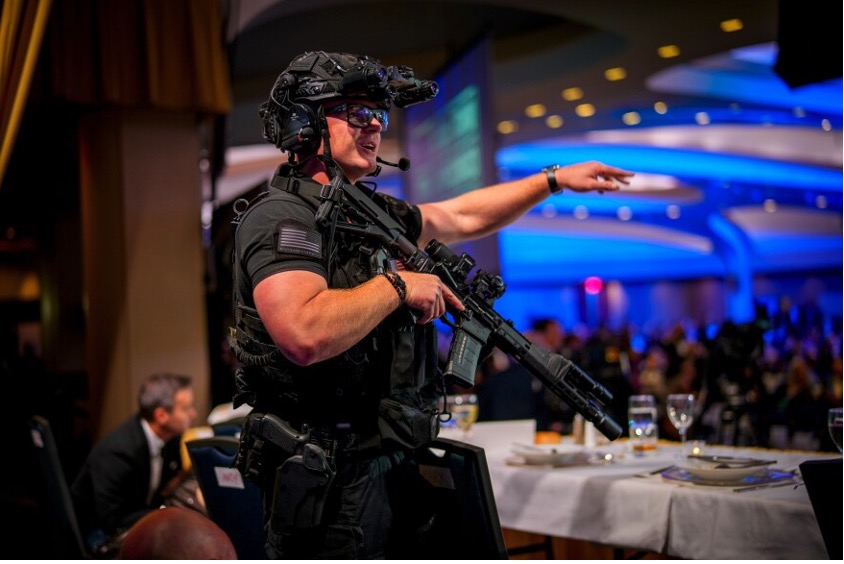
CORRESPONDENTS' DINNER CHAOS - The evening at the Washington Hilton left behind a sense of fear that is difficult to describe. Having lived in the United States for many years, I have grown accustomed to a public discourse that is sharp, often excessive. But what happened at the White House Correspondents’ Dinner (WHCD) seems to signal something deeper. American society is flirting dangerously with political violence, perhaps even with its own cohesion. The first reports spoke of gunfire, of an armed individual, and of a wounded Secret Service agent. The question that arose almost immediately was whether this was yet another assassination attempt against Donald Trump.
There is also a certain irony in the fact that the incident unfolded at an event dedicated to the press. A president who, in recent years, has repeatedly attacked the media –branding them “fake news” or “the enemy”– now finds himself at the center of an event where words give way to bullets. And bullets, unlike words, leave no room for misinterpretation.
There can and should be no doubt that political violence –and especially an assassination attempt against an elected president– is never a solution. It is a defeat for democracy, the moment when dialogue is replaced by this kind of absurdity. Whatever each American’s view of Trump may be, his physical elimination cannot be accepted as a political act.
At the same time, it would be naive to ignore the climate that has been taking shape. Exaggeration, demonization, and the constant use of extreme historical analogies –such as the easy invocation of Hitler–create an environment in which more unstable individuals may come to believe they are acting “for the good” of the country. When the public sphere is flooded with narratives of Trump as a liar and a villain, it is not inconceivable that someone might come to see it as their duty to shoot him.
In this context, social media plays a decisive role. Where anger is rewarded with visibility by algorithms and moderation goes unnoticed, public discourse deteriorates. And as society becomes increasingly polarized, these platforms continue to thrive economically, as if there is no cost to democracy itself.
The problem, however, is not limited to a single person or a single party. For years, both Republicans and Democrats have drifted away from the everyday concerns of ordinary citizens. Workers, families, and young people seeking a better future often find themselves without representation in a political discourse that is frequently trapped between populism and ideological extremes.
If there is one lesson from today’s moment, it is that the United States needs a kind of leadership that recalls the unifying force of figures such as Abraham Lincoln or Franklin Delano Roosevelt. Leaders capable of building bridges, of inspiring, of caring for everyone, of keeping their word, of speaking honestly about problems, and of restoring trust in institutions.
Especially for the Democratic Party, the challenge is clear. Confronting the Trump phenomenon will not come through a sense of “moral superiority” or rhetorical condemnation, but through a moderate proposal that speaks to the real needs of American society. Not with slogans aimed at a narrow audience, but with policies that offer answers to broader segments of the population.
In conclusion, America stands at a crossroads. Political violence is pushing it backward, toward times that resemble the Wild West more than a modern democracy with a strong tradition. The way out can only come through a return to reason, to respect, and above all, to the realization that without a unifying spirit there can be no future for the leading power of the West. And where is a Lincoln? Where is a Roosevelt? Surely, a country of 340 million people cannot be incapable of producing such a leader once again.
(Dimitris Eleas is a New York City–based political scientist, writer, and independent researcher. His e-mail is: dimitris.eleas@gmail.com.)