Comments
THE BOTTOM LINE - The Los Angeles mayoral debate was supposed to reassure voters. Instead, it exposed something far more alarming: a city trapped between public anger, political dysfunction, and collapsing confidence in City Hall.
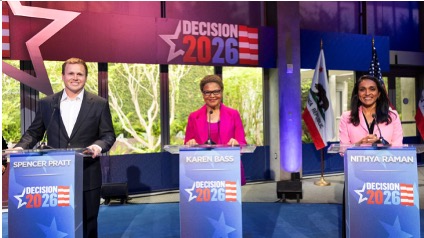
On stage Wednesday night, Karen Bass faced relentless attacks from challenger Spencer Pratt and Councilmember Nithya Raman in what quickly became less of a debate and more of a public autopsy of modern Los Angeles.
Wildfires. Crime. Homelessness. Corruption. Public safety. Budget failures. Empty reservoirs. Fentanyl. Encampments. Downtown decline.
Issue after issue piled onto the stage like evidence in a case against the city itself.
And for millions of Angelenos watching, the most disturbing realization was simple:
Nobody truly appears in control anymore.
The January 2025 Palisades wildfire disaster became the emotional centerpiece of the night. Bass defended her administration by pointing to homelessness reductions and housing efforts while arguing Los Angeles inherited deep structural failures long before she took office.
Pratt turned the wildfire response into a direct indictment of City Hall competence.
He accused officials of ignoring basic preparedness, failing to secure emergency infrastructure, and mismanaging reservoirs during one of the city’s worst disasters.
“As mayor, I will never drain the reservoirs that we need for wildfire protection,” Pratt declared.
Bass forcefully rejected his claims, while Raman positioned herself as the reform-minded alternative focused on preparedness and accountability.
But beneath the political crossfire, the debate exposed something even more dangerous than disagreement:
the collapse of public trust.
Public safety quickly became another battleground.
Bass highlighted federal drug raids tied to MacArthur Park while arguing Los Angeles desperately needs more police officers. Raman defended alternative response systems and accountability measures. Pratt leaned aggressively into a law-and-order message that clearly tapped into growing frustration across the city.
The divide between City Hall rhetoric and public reality could not have been clearer.
Officials talk about statistics.
Residents talk about survival.
They talk about burglaries, abandoned sidewalks, drug activity, vandalized storefronts, and neighborhoods where basic order increasingly feels optional.
Across Los Angeles, residents are adapting to conditions that would have been politically unthinkable a decade ago.
Parents walk children past tents and open drug use on their way to school. Businesses that survived recessions and the pandemic now question whether they can survive Los Angeles itself. Downtown office towers sit half-empty while entire corridors project decline instead of opportunity.
For many Angelenos, dysfunction is no longer shocking.
It has become normalized.
Homelessness remained the defining issue of the debate and the clearest symbol of public exhaustion with City Hall. All three candidates agreed that when shelter space exists, unhoused individuals should be required to move indoors. But beyond that agreement, the debate exposed deep divisions over enforcement, spending, and accountability.
Then came the issue that may haunt City Hall the most:
corruption.
Federal investigations tied to homelessness spending have intensified public suspicion surrounding billions of taxpayer dollars flowing through nonprofits, contractors, and agencies with limited transparency and inconsistent outcomes.
Asked how residents could trust the system, Bass acknowledged corruption concerns directly.
“I don’t think it’s shocking that you do find corruption in big programs like this,” the mayor admitted.
That moment may have been one of the most politically damaging exchanges of the night.
Because the crisis facing Los Angeles is no longer simply homelessness.
It is the growing belief that City Hall has lost control of both the crisis and the money surrounding it.
Raman attempted to separate herself from Bass through calls for stronger oversight and measurable outcomes. Pratt dismissed both Bass and Raman as representatives of a failed political establishment while portraying himself as the outsider willing to confront systemic dysfunction directly.
At one point, Raman suggested Bass and Pratt were politically targeting her because they viewed each other as easier opponents.
Pratt responded bluntly:
“If I wanted to run against anybody, it would be the councilmember who is terrible.”
Meanwhile, Bass repeatedly returned to the same defense: Los Angeles was already in crisis when she inherited it.
For many frustrated voters, that explanation is beginning to wear thin.
After years of rising homelessness costs, worsening public distrust, business flight, infrastructure decay, budget instability, and visible deterioration across the city, residents are no longer asking who inherited the crisis.
They are asking who is capable of ending it.
And looming over the debate was the reality neither side could escape:
the 2028 Olympics are approaching rapidly while Los Angeles still struggles to deliver the most basic functions of local government.
The debate made one thing painfully clear.
Los Angeles is no longer debating how to thrive.
It is debating whether basic governance still functions at all.
And unless City Hall delivers visible, measurable results soon not slogans, task forces, or carefully staged press conferences, but real results residents can see with their own eyes voters mt. ay conclude that the greatest threat facing Los Angeles is not homelessness, crime, corruption, wildfire failures, or budget deficits alone.
It is the leadership culture that allowed all of them to spiral out of control at the same time.
Los Angeles is not collapsing because residents stopped believing in the city.
It is collapsing because residents are beginning to lose faith in the people running it.
(Mihran Kalaydjian is a seasoned public affairs and government relations professional with more than twenty years of experience in legislative affairs, public policy, community relations, and strategic communications. A respected civic leader and education advocate, he has spearheaded numerous academic and community initiatives, shaping dialogue and driving reform in local and regional political forums. His career reflects a steadfast commitment to transparency, accountability, and public service across Los Angeles and beyond.)